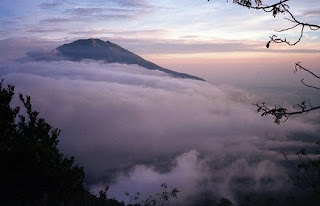
Merapi volcano is one of the world's most active and dangerous volcanoes. It contains an active lava dome, which regularly produces pyroclastic flows. It has been active for 10,000 years.
This fire mountain remains one of the most active and dangerous volcanoes in the world. It can be seen from its name; Merapi from Javanese word 'Meru' means 'Mountain' and 'Api' means 'fire'. The internally giant smoking Mount Merapi is one of the active volcanoes that found in Indonesia. It is presenting its peaceful and sleepy dense forest.
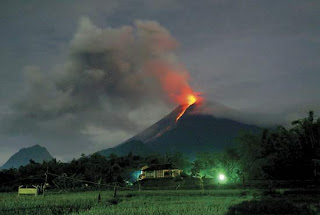
Beyond this, there lies a vast deserted land with its deep and steep valley spread out among the mountain hills where sibilant pines and wild grass make out the dominating vegetation, all presents a very exciting panorama. Merapi is located about 30 km north of Yogyakarta, a city with a population of 500,000. It is tall (2.8 km or 1.7 miles high) and has steep slopes. The top of the volcano sometimes has a normal crater, but usually a broad mound of pasty lava (called a dome) fills the crater. The dome plugs up the volcano, making it difficult for other lava and ash to escape. A broad gouge funnels lava and ash flows from the top of Merapi to the south slopes of the volcano.
Read More..
|


Tawangmangu is located 40 km east of Solo, this recreational resort offers fresh weather; scenic views, swimming pools, bungalow style hotels and restaurants. Tawangmangu,
a mountain resorts at an elevation of almost 1 km above sea level, which promises a cool escape from the city's heat. It lies on the slopes of Mt., Lawu, at an elevation of 1300 m above sea level. A cool splendid hill resort also on the slope of mount Lawu, at about 1400 M height above sea level. The road from Solo via Karangpandan is a fine trip thru magnificent green terraced hills. Tawangmangu has all kind of facilities, hotel, camping ground, forest tourism, etc. The climate is fresh and one can enjoy the beautiful scenery. Other features include nearby temples, a national park and 40m in high waterfall of Grojogan Sewu.
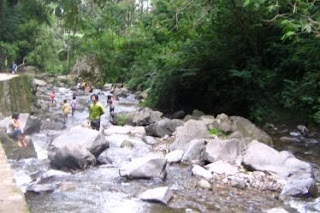
It is a 100 M high waterfall; the pool at the bottom has very chilly water. In front of the gate to Grojogan Sewu, horses for rent are available to ride around Tawangmangu.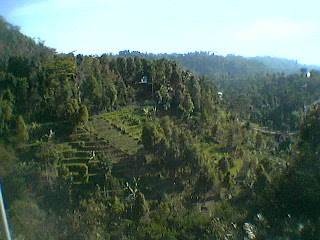
Read More..
|
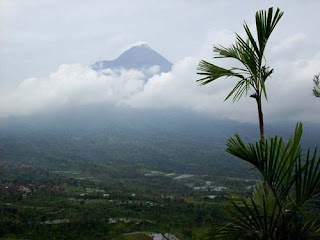
Ketep Pass atau Bukit Ketep, berada pada ketinggian 1.200 dpI dengan luas area sekitar 8.000 m2
. Terletak di Desa Ketep, Kecamatan Sawangan jalur Solo-Selo-Borobudur, sekitar 21 km dari Kota Mungkid , 17 Km dan Desa Blabak ke arah timur, 30 Km dari Kota Magelang, 35 Km dari Kota Boyolali dan 32 km dari Kota Salatiga melalui Kopeng. Dari gardu pandang ini wisatawan bisa melihat pemandangan Gunung Merapi, Merbabu, Sumbing, Sindoro, Tidar, Andong dan Pengunungan Menoreh serta hamparan lahan pertanian. Dan tempat ini bisa melihat luncunan lahar panas Gunung Merapi.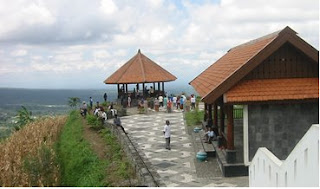
Atas prakarsa Gubernur Jawa Tengah H. Mardlyanto, dipilih tanah berbukit mi untuk dikembangkan sebagal tempat tujuan wisata baru di jalur Solo - Selo - Borobudur dengan Girl khas wisata kegunungapian Ketika diresmikan oleh Presiden RI Megawati pada 17 Oktober 2002 baru dibangun dua gardu pandang dan pelataran. Dengan keunggulan panorama yang atraktif Gn. Merapi - Merbabu, hamparan teras - teras tanah pertanian serta kesejukan udara, Ketep Pass makin ramai dipadati pengunjung, lebih - Iebih pada akhir pekan dan han libur. Awal tahun 2003, dibuka Volcano Theatre sebagam fasilitas baru yang menyajikan film tentang Gunung Merapi dengan berbagai aktifitas vulkaniknya. Fasilitas baru mi makin memperkuat ciri Ketep Pass sebagai tempat wisata kegunungapian. Bangunan ni dilengkapi restaurant yang berada di Iantai atas dengan pemandangan luas ke arah Gunung Merapi.
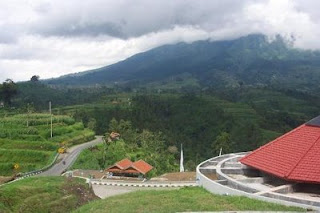
Kini telah selesai dibangun Volcano Centre. Sebuah bangunan seluas 550 m2 yang menyajikan berbagai materi informasi gunung berapi dengan sajian utama tentang Gunung Merapi. Kehadiran Volcano Centre makin memantapkan karakter khas Ketep Pass sebagai tempatwisata kegunungapian. Memasuki Bangunan Volcano Centre pengunjung akan diajak menjelajahi seluruh ruangan secara mengalir dan sajian materi satu ke yang lain, seolah tanpa putus. Dimulai dan informasi umum tentang gunung berapi dan informasi geologis yang tersaji dalam bentuk gambar, foto dan peta dalam format besar, selanjutnya pengunjung diajak secara interaktif menggali dan menikmati berbagai koleksi gunung berapi melalui perangkat komputer multi media. Contoh batuan yang dilengkapi dengan informasi teknis menjadi sajian berikutnya. Panorama Merapi dalam berbagai tampilan akan mengantar pengunjung pada sajian utama yakni miniatur Merapi dalam ukuran cukup besar. Bagian terakhir sajian adalah Mitigasi Bencana Gunung Berapi yang akan mengajak pengunjung se- cara langsung mengoperasikan peralatan peman tauan dan pende teksian gejala dan kegiatan vulkanik. Cinderamata khas yang hanya di jual di dalam Volcano Centre tersedia di bagian akhir perjalanan pengunjung. Di pintu keluar, melalul trap pengunjung dihantar ke pelataran tertinggi PELATARAN PANCA ARGA, di sini pengunjung dapat menikmati sajian panorama alam lima gunung besar di Jawa Tengah yakni Merapi, Merbabu, Sindoro, Sumbing dan Slamet Selain itu akan nampak pula gunung - gunung kecil lain seperti Telomoyo, Andong, Dataran Tinggi Dieng serta perbukitan Menoreh Bukit Ketep kini telah menjadi tempat tujuan wisata yang menarik dengan ciri khas sajiannya yakni kegunungapian. Atraksi wisata yang tidak hanya bersifat rekreatif tetapi sarat dengan kandungan pendidikan yang tersaji secara atraktit.
Read More..
|
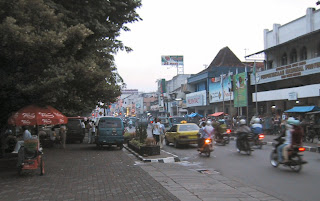
Jalan Malioboro (Malioboro Street) is a major shopping street in Yogyakarta, Indonesia
; the name is also used more generally for the neighborhood around the street. It runs north from the Yogyakarta kraton (palace) towards the roads that lead to either Surakarta to the east, or Magelang to the north, as well as Mount Merapi. This is in itself is significant to many of the local population, the north south orientation between the palace and the volcano being of importance.
The street is the centre of Yogyakarta's largest tourist district; many hotels and restaurants are located nearby. Sidewalks on both sides of the street are crowded with small stalls selling a variety of goods. In the evening several open-air streetside restaurants, called lesehan, operate along the street.
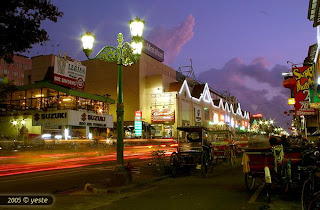
Less obvious to the tourist, but more for the local population, side streets, lanes and structures that lead on to Malioboro are as important as the street itself.
The street was for many years two-way, but by the 1980s had become one way only, from the railway line (where it starts) to the south - to Beringharjo markets, where it ends. The largest, oldest Dutch era hotel, Hotel Garuda, is located on the street's northern end, on the eastern side adjacent to the railway line. It has the former Dutch era Prime Minister's complex, the kepatihan, on the eastern side.
For many years in the 1980s and later, a cigarette advertisement was placed on the first building south of the railway line - or effectively the last building on Malioboro, which advertised Marlboro cigarettes, no doubt appealing to locals and foreigners who would see a pun with name of the street with a foreign product being advertised.
It does not reach the walls or grounds of the Yogyakarta palace, as Malioboro ceases in name adjacent to the very large market Beringharjo (on the eastern side as well). From this point the street changes name and has on the western side the former Governors residence, and on the eastern side the old Dutch Fort Vredenburg.
Read More..
|
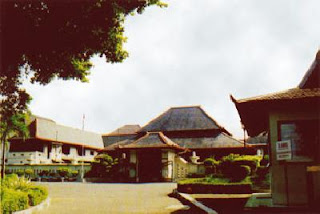
SONOBUDOYO MUSEUM
This museum is founded in November 1935 and designed by the Dutch architect Kersten. This Museum is built in traditional Javanese architecture. It
exhibits weapons, leather and wooden puppets of Wayang Theater, masks, statues, textiles, curios and old Javanese gamelan instruments. The museum is situated on the northern side of the city's main square in front of the Sultan's Palace. Sonobudoyo museum is located on the north side of the North Square of Sultan's Palace. 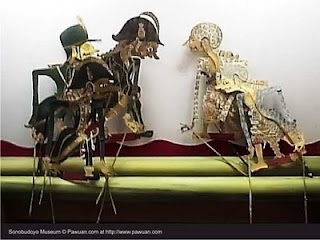
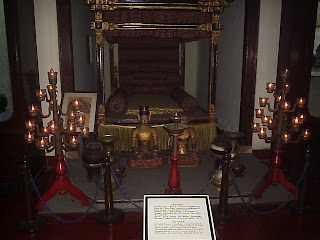
SONOBUDOYO MUSEUMIt was built in 1935 according to Javanese architecture. The architecture of gateway resembles to the entrance of the mosque in Kudus in the way to the auditorium and main Joglo structure, which are connected, while Kudus is the most ancient town in Java Island beside Kotagede. The museum has the second most complete collection of cultural artifacts after the central museum in Jakarta, like ceramic from the Neolithic Age, statues and bronze articles from the 8th, 9th and 10th century originating from Central Java temples, various kinds of masks and wayang (puppet for shadow play), a gamelan or orchestra, an ancient weapon collection, the looms and artifacts from Bali. This museum is also an interesting library that keeps various ancient books related to the Javanese culture.
Read More..
|
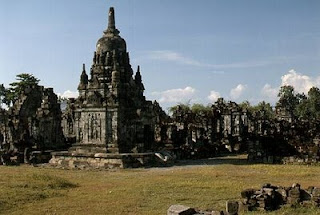
SEWU of THOUSAND TEMPLE
Sewu Temple is located 2 km north of Prambanan Temple. This is the second largest Buddhist Temple complex in Java; Restoration is
professionally underway to reach its original form. It is a MANDALA, manifesting the universe in the center temple of Mahadeva, surrounded by four rings of 250 smaller temples of Gods. Sewu Temple complex is located in Prambanan Temple Park area, about 800 meters to the north of Rara Jongrang Temples. The fact that this temple was built near Prambanan Temple, which is a Hindu temple, indicated that the Hindus and Buddhists lived in harmony.
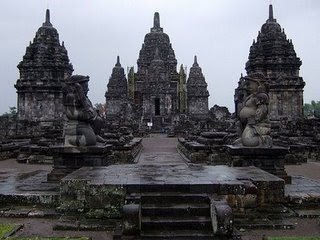
The main temple has 1 main room and 4 small rooms of which are doorways to the temple. The east door serves as main door to the main room. That way, the main temple faces to the east. The structure has 9 'roofs'; each of them forms a stupa on the top. It is believed to be a royal temple and was one of the religious activity centers in the past. Based on the inscription dated back to 792 AD, which was found in 1960, the name of the temple complex was probably "Manjus'rigrha" (The House of Manjusri). Manjusri is one of Boddhisatva in Buddhist teaching. Sewu Temple was probably built in the 8th century at the end of Rakai Panangkaran administration. Rakai Panangkaran (746 AD - 784 AD) was a popular king from the old Mataram kingdom. HC Cornelius studied the temple firstly in 1807. NJ Krom did the first archeological study in 1923.
Read More..
|


